


Call: 01270 501 501
Business Wayfinding & Directional Signage
Very few people study a site on arrival. Most will simply glance and guess, then keep moving, making a string of quick decisions about where to turn, where to park and which door to try. Every one of those decisions is a chance to impress a visitor or lose them.
Wayfinding signs and directional signage take the guesswork out, so people reach you calmly rather than cross. At MC Signs, we design and install wayfinding signs for sites of all sizes, from a single car park to a sprawling industrial estate.
The Questions Every Visitor Asks
The easiest way to plan directional signage is to think about what a first-time visitor is wondering at each stage.
Am I in the right place?
This question occurs at the perimeter. A tall post and totem sign at the entrance confirms the business name from a distance and, on shared sites, can point people towards the right unit.
Where do I park?
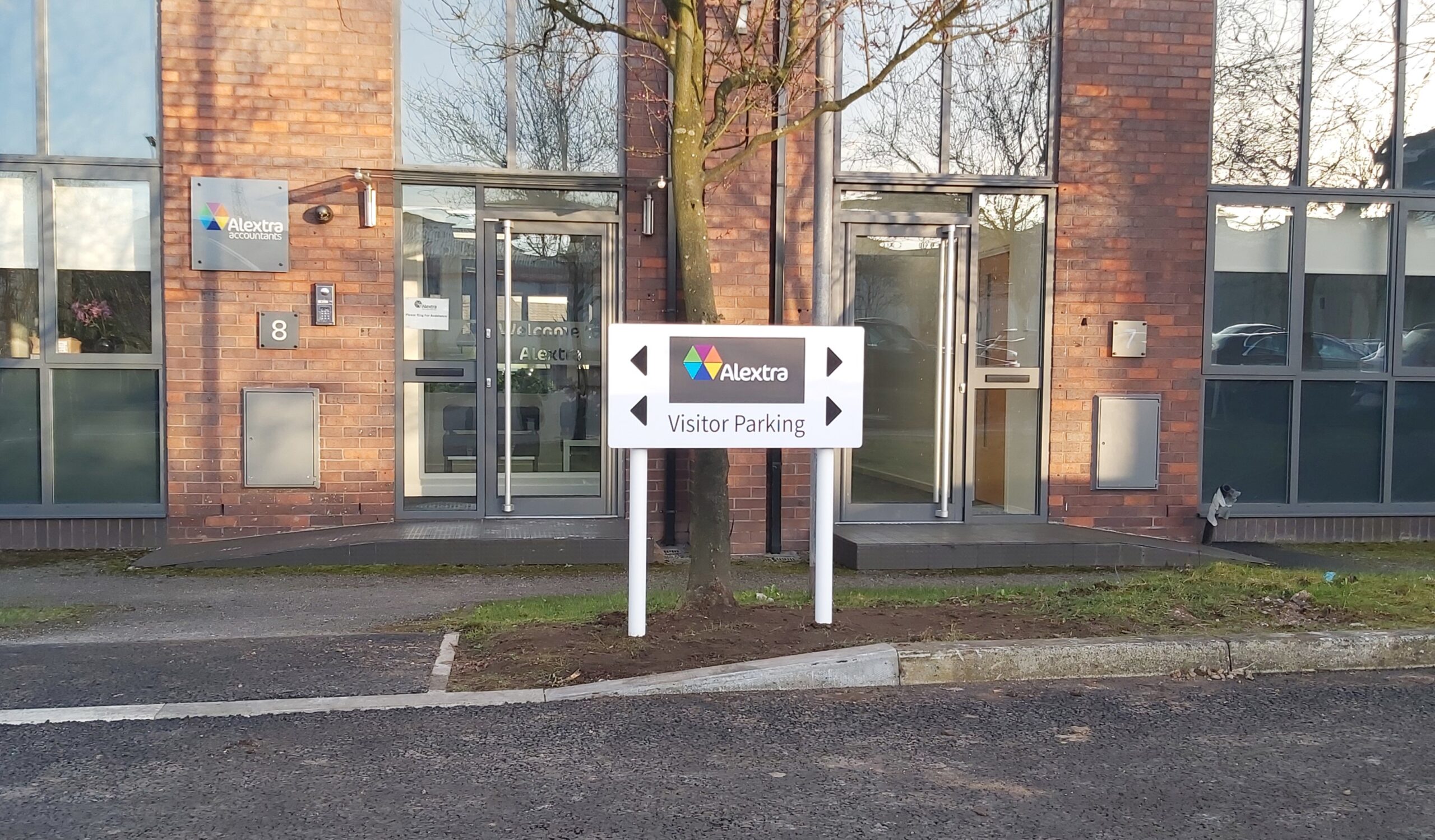
Drivers need answers before they’ve stopped. Clear car park signs and arrows keep traffic moving and keep visitors out of the wrong areas. The same applies to deliveries, which are far smoother when drivers can see where to go without phoning ahead.
Which way now?
Once visitors are out of the car, internal and external directional signage takes over. Tray signs mounted on walls or beside doors guide people around a building, and on complex sites, banners and frames strung to fencing can point customers round a layout that changes from time to time.
Where’s the exit, and what do I need to know?
Fire exits, assembly points and hazard notices are directional signage too. Our health and safety signs are produced with industry standard symbols so they can be understood at a glance.

What Makes Directional Signage Work Well?
Good wayfinding signs share a few habits. They appear at the point where a decision has to be made, not after it. Wording stays short enough to read while walking or driving slowly, and the style stays consistent from the first sign to the last, so visitors learn the pattern and stop reading every word.
Legibility matters more than cleverness. A survey by FedEx Office and the University of Cincinnati’s Economic Center found that both consumers and businesses rated legibility as the most important quality in a sign. A beautifully designed arrow that can’t be read from a moving car isn’t helping anyone.
Creating A System and Not Just a Scatter of Signs
The best wayfinding schemes are planned from the road inwards. A visitor might meet a totem at the gate, car park signs on the approach, a sign above the entrance and tray signs once inside. Each one picks up where the last left off. When signs are bought one at a time from different places, gaps and clashes appear, and visitors feel it even if they can’t say why.
Wayfinding suits many settings. It works for retail and hospitality venues, and for industrial sites where units are tucked away and footfall is low.
Plan Your Wayfinding Signs
Start by walking your site as a stranger would, from the road to the door, and note every spot where you’d hesitate. Send us those notes or a few photographs and we’ll recommend where each sign should go and what it should be made from, then take care of design and installation. Call 01270 501 501, email artwork@mcsigns.co.uk or use our contact form to get started.